Salt Water In Gambia Once Reached As Far As 150 Kilometers Inland; Now It's Poisoning Soil 300 Kilometers From The Sea
In this little village in West Africa, Ebrima Nyan is watching his farmland slowly wither away. When Nyan, 47, was a teenager, the village grew all the rice it consumed, in a field alongside the Gambia River. Now that field lies dry and empty, after the river’s brackish water intruded, rainfall flagged and the soil became too salty for crops.
By the early 2020s, the salt problem had moved farther inland from the river, to a field where the village grew onions, peppers, cabbage and eggplant, Nyan said. Seeds rotted, leaves fell off, plants shriveled. Bantang Killing’s farmers decided to abandon the field five years ago, though they still hold out hope it could produce again, if the soil was treated and salt kept out. “Even though you plant here, it will grow so small—not even grow to harvesting” size, Nyan said one spring afternoon, waving his arm at the fenced-off enclosure.
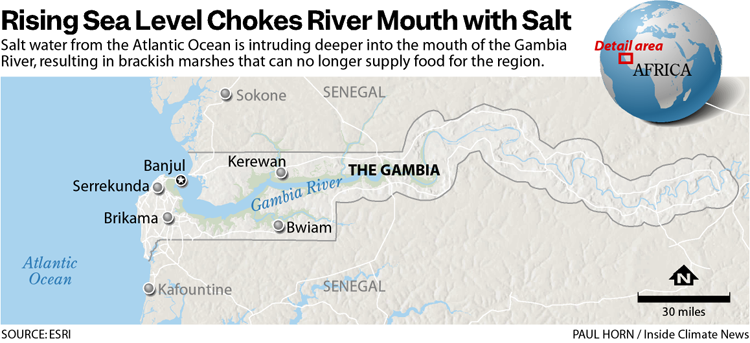
The little nation of Gambia is on the front lines of a global struggle with salt, as a combination of climate change and human activities push ocean waters further inland, threatening ecosystems, aquifers and agriculture. Most of the salt intrusion is taking place along coastlines and deltas, where rising sea levels send saline water flooding ashore, seeping underground and changing the chemistry of nearby land. Droughts increase salinity too, since there is less rainfall to dilute the salt or flush it out. Both phenomena are expected to worsen with global warming. Soil and aquifer salinity levels are also rising as the world’s coastal cities pump more fresh water out of the ground, in the process sucking ocean water in. In farming areas, the overuse of fertilizer can increase salt levels in soil as well.
EDIT
Today, the broad, flat, mangrove-lined Gambia River is still at the heart of the country that bears its name. Its banks provide several hundred kilometers of inland coast that host most of the country’s agriculture—both subsistence rice and vegetable farming, largely handled by women, and cash crops like peanuts, grown by men. Since agriculture accounts for a quarter of Gambia’s gross domestic product and 70 percent of employment, keeping the inland coast productive is supremely important. “These river banks are essential land for agricultural production in The Gambia, especially in our drive to mitigate and fight against food insecurity,” said Jalamang Camara, a director at the country’s National Agricultural Research Institute, or NARI.
https://insideclimatenews.org/news/12072026/gambia-sea-level-rise-agricultural-crisis/
